Sideways—A Conversation with Harald Møller
Internationally renowned Magnum photographer Jonas Bendiksen and collector Harald Møller stand on opposite sides of the photographic transaction: one takes the photograph, the other observes it. At the same time, both share a lifelong passion for documentary photography and images that emerge in the peripheral field of vision. They met in February 2021 for a conversation about the Møller Collection.
The interview is taken from the book *Eksponert* (2021) and is reproduced with permission from Forlaget Press.
What does it take for a picture to work?
To find out if a photo speaks to me, I hang it up in my office. After two weeks, I ask myself: Do I still want to look at this, or should I take it down? Has it finished telling its story, or is there more to it? It might be a very beautiful photo, but it could still have nothing more to say. There are so many beautiful photographs that work better in other contexts. Photo books work well when the images are meant to tell a larger story.
Does a photograph have to tell a story? Isn’t it enough that it’s beautiful to look at?
That might be enough, but then the question is: what is it that makes it appealing? After having them on my wish list for a long time, I recently bought some modernist black-and-white nature photographs by Per Berntsen. It’s human nature to systematize, generalize, and see connections. I myself have a relatively conservative eye; I look first for compositions and patterns—classic aesthetic qualities. Why am I drawn into these sparse depictions of a few trees? My eye works intensely to try to capture a pattern that isn’t there. That in itself may be enough to make the image linger before me for a very long time. It just buzzes and keeps going all the time. I think many people might find such images rather boring, but I felt that these were photographs that linger. Something similar happens when I look at Tom Sandberg’s work. There’s a kind of calm, yet at the same time there’s such a strong intensity to it. When I look at his images, something begins to chug away inside me.
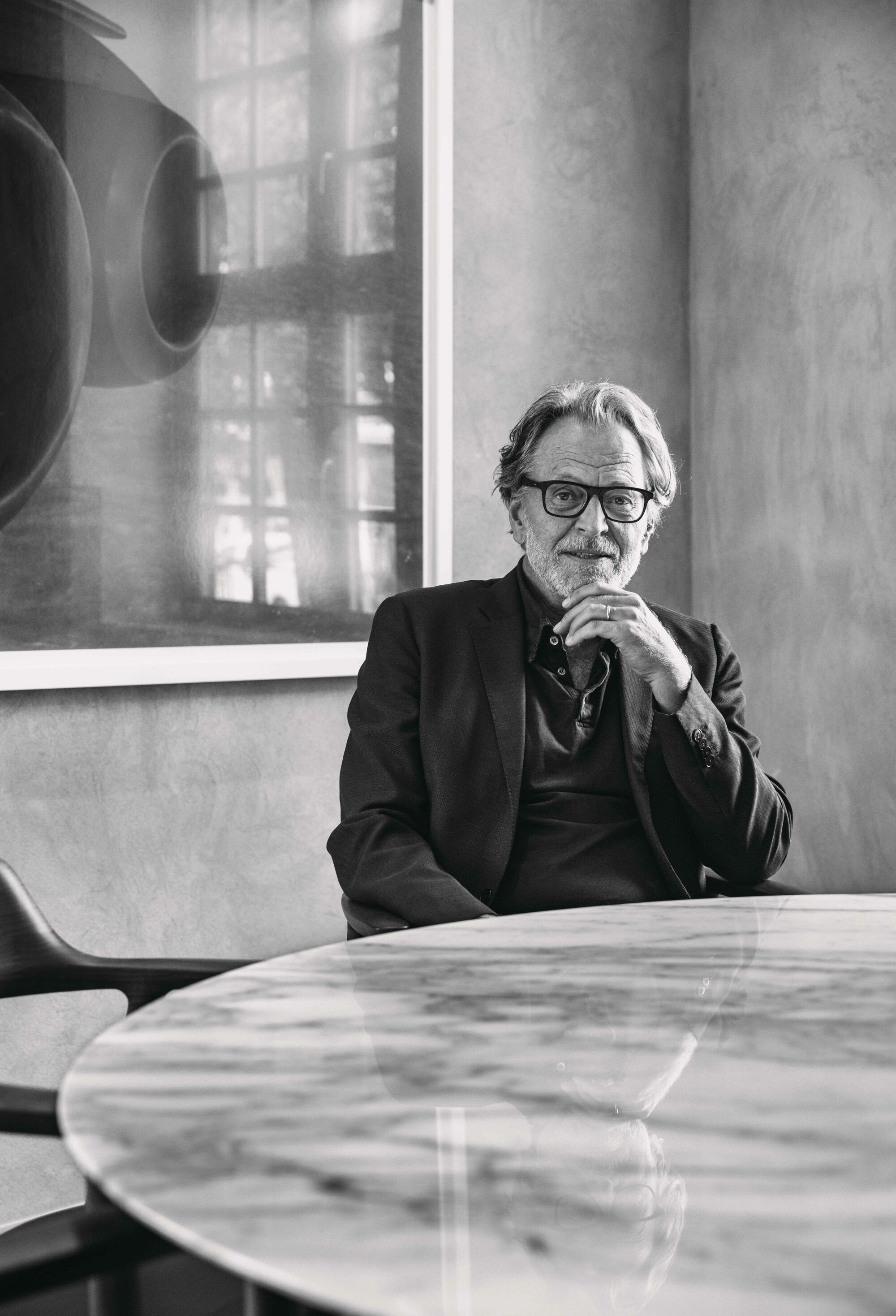
Harald Møller: Photography enthusiast and owner in Aars, which in turn owns the Møller Collection.
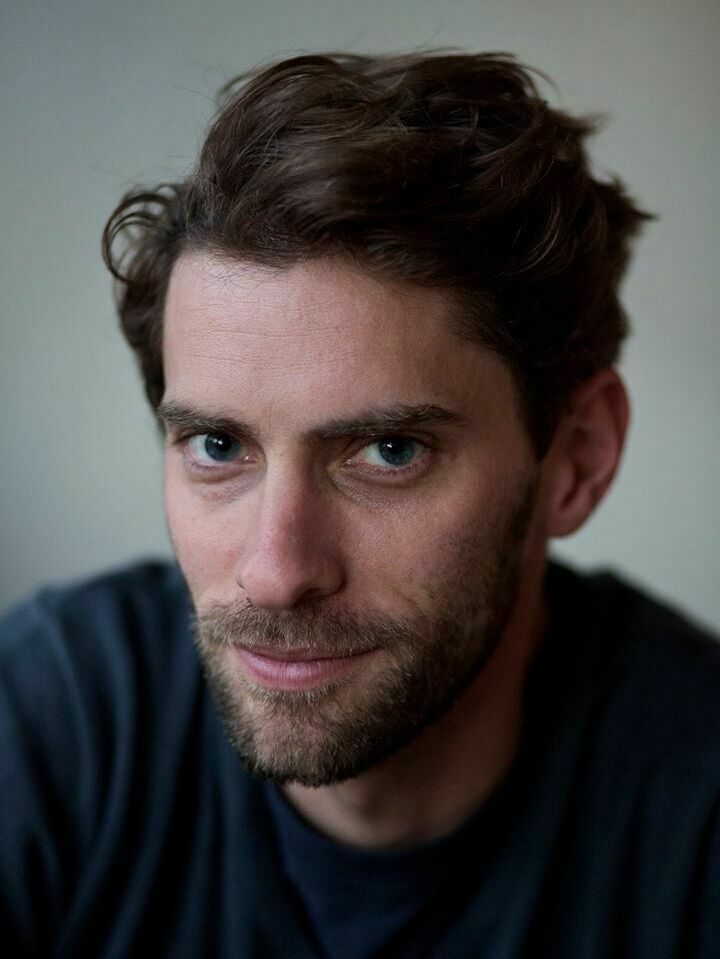
Photographer Jonas Bendiksen.
The collection includes many photographs that were not created to be displayed on a gallery wall. What draws you to images of atomic bomb explosions?
They’re part of our history. France conducted nuclear tests in the Pacific longer than anyone else. Most people have forgotten that now, but all of Norway boycotted French wine for several years in the 1990s. The municipality of Gjøvik passed a resolution to boycott the purchase of French cars. We bought the photo recently. I’d told myself I’d never buy a photo online, but because of the coronavirus, we ended up participating in an auction in New York.
In my view, paradoxically, this is one of the most beautiful photos in the collection. Photography often ends up far removed from the photographer’s intention or assignment. Photographs perhaps have a more independent life than other art forms.
I find it visually striking—in a frightening way, of course. It’s hard to look at, but there’s something very powerful about it. Aesthetically speaking, it’s all about death and decay, but at the same time, it’s evocative in its cruelty. We enlarged them and made them bigger than they were. I wasn’t too concerned about the French government’s copyright.
After more than 20 years as a photographer, I find myself wondering more and more what actually constitutes a good photograph. I haven’t gotten any closer to an answer since I started. Quite the opposite.
I studied communication, so I went through a phase with Roland Barthes’ semiotics and all that. After a while, I broke with that. I’m easily provoked by art critics and curators who try to tell me what’s valuable in a work. I just end up feeling alienated. Photography is democratic. A good photograph—it’s pretty intuitive—it appeals immediately. Some images are raw and direct, while others creep sideways into our minds. I like best the ones that creep in from the periphery—the ones that aren’t too in-your-face. I’m interested in the present—poverty, war, and social inequalities. These are all themes that photography handles better than other media, and it’s precisely that subtle commentary that draws me in. If you take 9/11, for example, we have a photograph by Sean Hemmerle that was taken inside a shirt store. You can just barely make out the ruins of the Twin Towers in the background. Instead of focusing directly on the disaster itself, the towers serve as a backdrop that reveals something more. You have to spend a little time looking at it.
I find that photography isn’t the easiest medium for conveying complex trains of thought or drawing conclusions. But it’s a pretty good tool for asking questions, presenting issues, and sparking curiosity. I imagine that Metinides’ car accident motif raises quite a few questions.
Even in death, one can see something beautiful. I noticed this image when it was first published and circulated internationally in the 1970s. It stuck with me. Many years later, I met the gallerist who handled Metinides’ works at Paris Photo and asked if I could get a print. The copy I received is probably far too large, so it comes across as a bit overwhelming. It’s about 50 centimeters wide, and it should have been half that size. Ideally, you’d have to get right up close to this image to study it.
But it’s still something you hang on the wall?
It’s still up in the office, but of course we have to be a bit considerate. It hung on the wall for a long time, but eventually an employee mentioned that he found it unsettling and would like to have it taken down. That was fine, of course.
I saw an estimate the other day showing that around 1.4 trillion photos will likely be taken in 2021. That’s about 3.8 billion photos every day—probably roughly the same number that were produced annually in the 1960s, back when a large portion of the photos in your collection were taken. We live in a completely different media landscape now. Back then, photography was a kind of scarce commodity; people didn’t know what places looked like, and the photographer’s job was to show them. Today, of course, we have the opposite problem. We’re drowning in visual impressions and lacking stillness and concentration. So what’s the point of collecting photographs?
Something happens when you pull a photograph out of that tsunami, when you frame the image and hang it on the wall. You select something from the chaos and say, “Stop! Here’s something you should spend a little more time on; someone is trying to tell you something.” I think it’s fantastic that there’s so much photography, but it undoubtedly makes it more challenging. We’re always playing catch-up, especially with more modern photography. I find it harder to buy color photos. Why? It has to do with aesthetics—it’s much easier to bring out the light in a black-and-white image.
Does it have anything to do with the fast-paced spirit of the times? Back then, the craftsmanship was more evident in the process—with darkroom work and chemicals—and photographers were a kind of alchemist? Now most prints are produced directly from the digital file on large-format printers that can churn out an endless number of identical copies.
Yes, the magic of the darkroom is gone. When digital C-prints first came out, I refused to buy them for a long time. No one knew how long they would last; the processes were completely new. I want them to last at least 100 years.
Your collection includes several of the truly great photographic icons—images that everyone recognizes, which form part of a collective narrative. In our hypervisual age, can images even become iconic in the same way?
I had some art enthusiasts visit my office last year, and I picked out an image from the news feed. A dead man lay on the street in Wuhan, China, surrounded by healthcare workers. To me, it was an iconic image because it told the rest of the world just how serious this epidemic was. It told me that this was coming our way very soon.
But do images last? Yes, they were powerful that day, but do they endure over time? Will people 20 years from now have this image etched in their minds as a marker of our era? I have no doubt that the image has the right ingredients to be an icon, and all the necessary symbolism. But aren’t there just far too many competing images? By “icons,” I mean images that become widely recognized and stand as a kind of visual milestone for an era. I can hardly recall an image from the last ten years that I think will remain in the collective consciousness in that way. We all know the most famous images from World War II, the 1960s, or the Vietnam War—but what was the iconic image from the Iraq War?
Photographers aren’t allowed in there, after all. Photographers helped bring the Vietnam War to an end. If photographers hadn’t been allowed to stay out in the jungle alongside the soldiers, the war would have gone on much longer. That was probably also the last war where photographers were allowed relatively free access, even on the front lines. I’ve never been to Afghanistan or Iraq as a photographer, but I think there’s quite a bit of control over what they’re allowed to photograph. Perhaps with the exception of soldiers who’ve taken pictures with their cell phones.
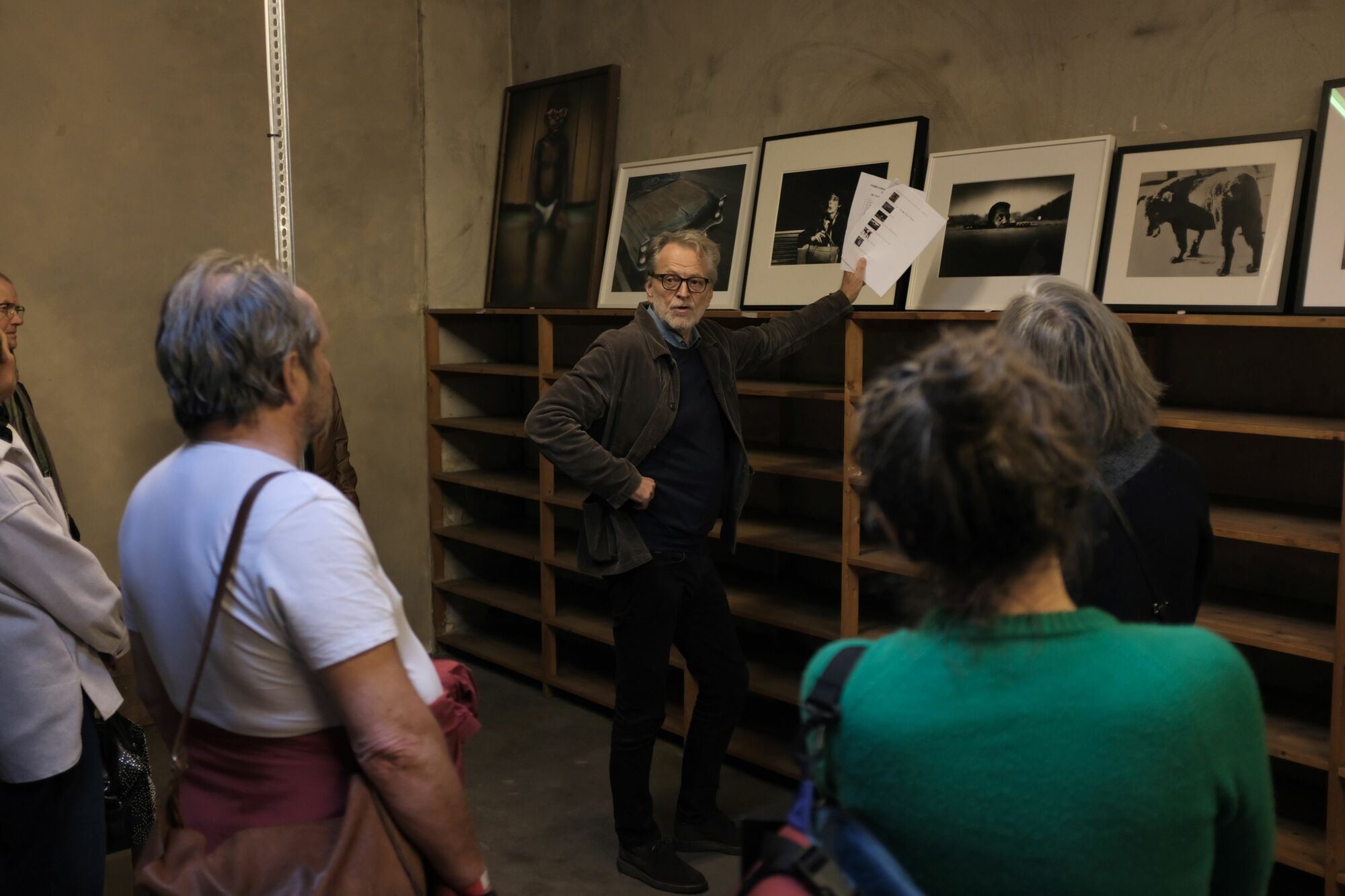
During Oslo Negativ in 2022, a selection of works from the Møller Collection was exhibited in the “attic” of the Old Deichman Library. The photograph was taken during a guided tour for the public led by Harald Møller.
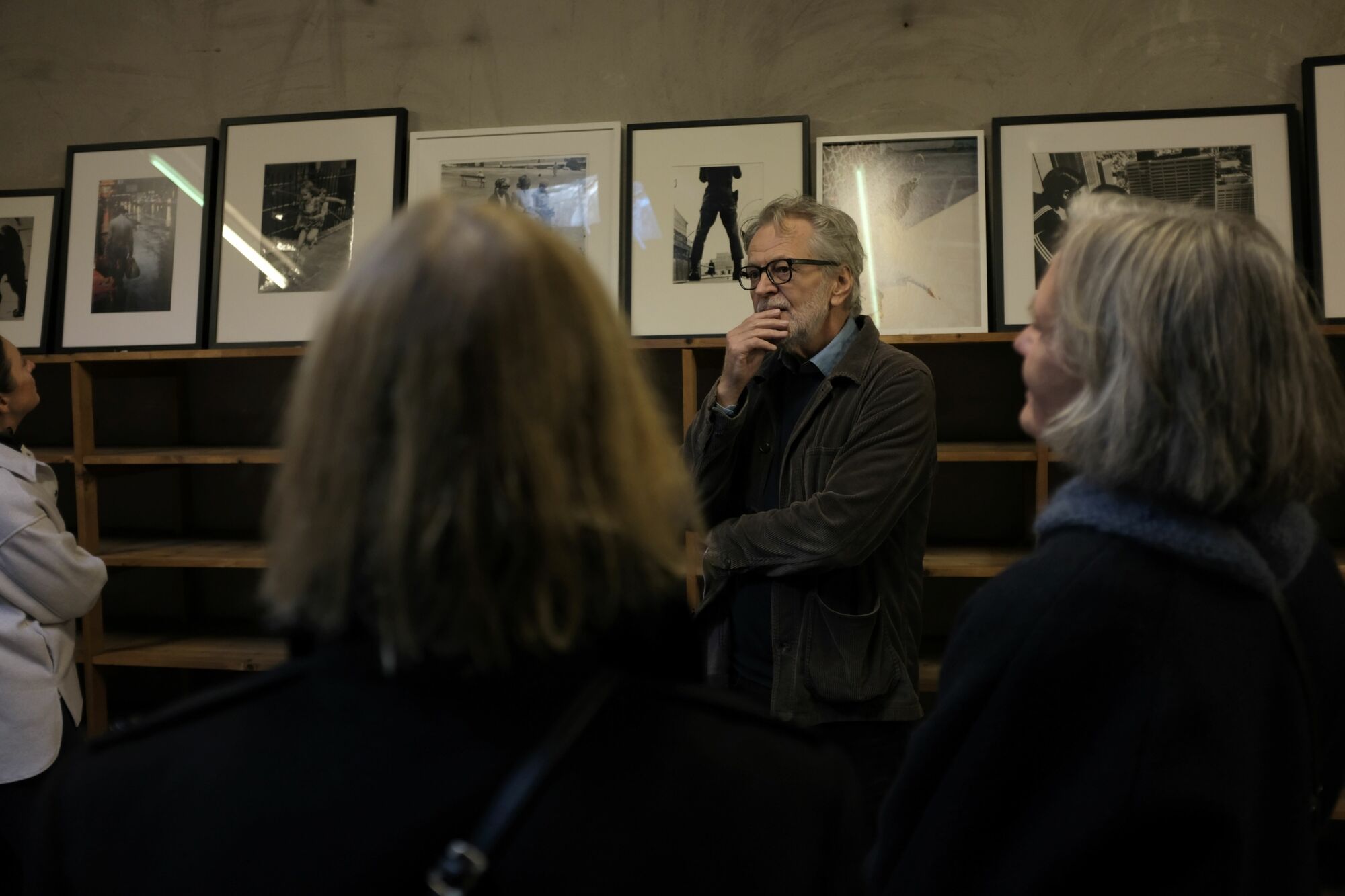
The Møller Collection continues to grow, and through the collection, Aars hopes and aspires to make a meaningful contribution to photography in Norway.
Yes, perhaps the only iconic image from the Iraq War is the cell phone photo taken by the American torturer himself—of the prisoner standing on a bucket with a bag over his head—taken to brag to his friends. Would you want that in your collection? It was, after all, a very important image for the public and the public debate, wasn’t it?
No, that photo is way too direct. Take the photo from Syria by Mattias Bruggman instead, where the soldiers are lying around relaxing by the swimming pool. It’s an incredible photo. It offers a slightly oblique perspective on the war. Bruggman told me how hard he worked to position the people in the pool just right, to capture the compositional lines along with the artillery position right behind the awning, and the city burning in the very background. It conveys a story, and at the same time, it’s fascinating on an aesthetic level. I don’t understand those who just have the money, rush out and buy 150 iconic images, and call it a collection. The times I’ve bought iconic images, I’ve often regretted it a bit, because it feels like following the book a little too closely. Anyone can do that. All you have to do is talk to ten specialists, make a list, and then go out with a big budget and acquire the paintings. There has to be more passion and more essence to a collection than just having an oil fortune and hiring a bunch of experts. That’s not how I want it.
I noticed this photo by Robert Charlotte. It’s fairly recent, from 2019. How much does the fact that it’s by a well-known name factor into your search for photos?
There are many different types of collectors. I’m one type, and I’m not the “hoarder” type. I’m not particularly concerned with the photographers. I’m concerned with the photos themselves and how they affect me.
I was at Art Basel, at a side exhibition featuring up-and-coming artists, where I noticed this photo. It speaks to me, and it has a delicate photographic balance. I wonder who he or she is—it’s very ambiguous. I also don’t know where it was taken. The colors and composition make me ask myself a lot of questions; it piques my curiosity. When I saw the photo for the first time, I’d never heard of the photographer. It wasn’t until after I’d bought it that I went online to find out what else he’s done. In the end, it’s just this one photo that really captures my interest. I’m not concerned with whether it’s valuable or not. I just think it’s good photography. But it’s not an icon; it’s more of a commentary.
Perhaps the defining factor of a good photograph—regardless of whether it was taken with a Hasselblad or a cell phone—is whether it makes me feel something? Does it spark my curiosity? Do I enter into a dialogue with it? I know exactly what it looks like—what has traditionally been called a “good photo.” We’ve all had it drummed into us from birth. And photos that resemble this “good photograph” are currently being produced in absolutely insane quantities. Hundreds of these perfectly fine and technically competent photos whiz through my Instagram feed every single day.
Yes, or like the thousands of photos I recently took in the mountains.
Many of them are surely absolutely perfect snapshots. But I’m really unsure whether any of this can actually be defined as “good photos” anymore. Few of them evoke any emotions in me. I suppose we’ve all become a bit visually desensitized. Maybe they worked when I was 14 and flipping through Mom and Dad’s National Geographic magazines. That’s when I was first exposed to photography and had a real “aha” moment. None of my children will ever have that moment—they’re bombarded with photography from their very first week of life. The way I see it, a truly good photo can be completely poorly composed, as long as it stirs something in me or makes me wonder about something.
I think it has to do with aesthetics, regardless. Why do Tom Sandberg’s photos work? Well, he chose a specific frame, and he poured his whole self into working with that frame. He was, after all, a bit of a workaholic, so he’d stay in the darkroom all night until he was satisfied with that one frame on very large prints. There are many ways to spark curiosity. I think Nick Brandt is a fantastic photographer. At first, I thought the photographs he took of elephants on the savanna were of high quality—everything was beautiful—but they were probably nothing more than postcard images. Over time, he completely transformed his approach to photography and placed these old nature images in entirely different contexts. The image in the collection is from a rather brutal location under a bridge in Nairobi, but Brandt adds a layer of historical context—about changing habitats. I’m not always a fan of staged shots, but this one really struck a chord with me, and I can see that it resonates with others as well. It’s an image you can stand and study for a long time.
You have Anne Kathrine Dolven’s photograph in a very large format. Does it come from a video work?
The way I see it, this image is really a portrait. I saw the video first and liked the story she tells. The photograph may not convey the story itself quite as well as the film. But there’s something very graphic about it. There are those three elements—it’s almost abstract—but for me, something happens when you notice the eyes of the woman lying in the middle, which are a little hard to see. The video work is, in essence, a portrait of her. She looked into the camera for a quarter of an hour—the entire time it took a dancer to crawl through all the other people, in a sort of horizontal monolith.
Does the image then become a kind of memento from the video work? Or was it the photograph itself that triggered your immediate reaction?
I wouldn’t say it was a punch to the gut, more of a delicate feeling—one I feel I can spend time reflecting on. Here there are people, misery, homeless people. It evokes a lot of associations for me. Many people walk past the image without fully understanding it. But if you draw people’s attention to the young girl lying in the middle of the image, they spend more time looking at it, and that’s when the good stories emerge.
What do you think this collection says about you?
The collection isn’t just about me. I started collecting in the early ’80s and have added to it gradually. In 2005, we purchased a large collection from Tore Holter, the former editor of the magazine *Fotografi*. That brought in a lot of material I might not have bought myself. Today, decisions are made by a committee consisting of me, family members, and colleagues. I find it a lot of fun, but the majority doesn’t always want to acquire everything I would have chosen if I were on my own. But my background is what drives me. I grew up in the ’70s and ’80s, in the wake of the Vietnam War, and was introduced to these images through *Life* magazine and *National Geographic*. I’d sit and flip through the pages, and it was amazing. That’s how I discovered the world. Those of us who grew up back then were allowed to get up to just about anything. We were rowdy and experimental. My dad sent me out in a tiny little sailboat off the coast of Tønsberg when I was 14, and then I sailed for several days with my 13-year-old cousin. A small storm came up, and it wasn’t really a problem at all—we managed to make it back to shore somehow. Today, it would’ve been Child Protective Services, the police, and the whole shebang. We were just told to stay out—everything was allowed—and we got up to all sorts of mischief. I think the collection has come together largely because of this background. There’s a lot of life in it, and I hope there’s some humor, too. It’s supposed to be fun.
I took a look at your photo storage room, and it struck me that it’s tiny compared to the size of your collection. Three by three square meters, a couple of drawers, and a few shelves. Have you deliberately limited your storage space so that the photos have to be on display most of the time?
I’ve met collectors who won’t even tell me what they have. It’s a secret. Some art collectors keep absolutely all of their art in a vault in Switzerland. I don’t quite see the point of that. After all, art exists to be displayed. A collection says something about who you are, and when you display it, you also offer a glimpse into another side of yourself. This collection started out very personal, but has grown into something more over time. It’s still a family affair. Everyone has become interested in this. The family goes to Paris Photo together with our curator, Nina Sørlie, and colleagues from our companies. It’s a lot of fun, because the collaboration takes the collection in different directions.
Charlie White stands out as something of an outlier in the collection, a far cry from the classics of the ’60s. What strikes you about this?
This is as staged as it gets. White uses Hollywood sets and puppet makers, and I doubt he even pressed the shutter button himself. There’s a lot of Photoshop. When I was growing up, we were taught that “a picture never lies” and “a picture is worth a thousand words.” Today, I suppose the first has turned into “a picture always lies.” I think we need to step into this space, too. We need to come in here and showcase works where the image lies more than anything else. I suppose I have a certain desire to provoke, and these are images that have a powerful, eye-catching effect. There’s a lot of humor in them. I hung them on the wall when we had offices on Wergelandsveien. We had an employee, a great guy who had grown up surrounded by ship paintings at home. At first, he didn’t want to come to work, and he certainly didn’t dare have meetings with anyone in the office. There were just white walls, a white floor, a white ceiling—and these bizarre pictures.
So productivity at Møller Eiendom dropped sharply when these pictures went up?
It caused quite a stir, not just among us, but also among those who came to visit us. This was around 2005. The funny thing was that, over time, he grew to love the ship paintings more and more, and when we took them down and hung up a typical black-and-white street photograph, he missed the Charlie White pictures. That’s when I thought: “Wow! Photography can do this, too!”
Is the collection part of a desire to capture the full diversity of life—with its ups and downs, tragedy, comedy, beauty, and cruelty—and have it all displayed on the office wall?
I think it’s a somewhat impulsive rebellion against the art elite—and perhaps the very paradigm of art itself. What is art? This is very individual, and I don’t think we should over-intellectualize what constitutes art. It’s about personal experiences. Not everything has to be institutionalized and analyzed. After all, isn’t it the viewer—the one who experiences it—who should decide whether it’s art or not?
For someone who’s in a private rebellion against the art world, it must be a kind of sweet revenge to take over one of Norway’s artistic strongholds, the Henie Onstad Art Museum, with his life’s work?
No, but the fact that the collection has now grown so large. And it’s very rewarding to see that it has now been curated. Some new perspectives have been introduced into the collection, which I’m very happy about. The collection is becoming important to so many people that being able to exhibit it and adopt a more museum-like approach is extremely valuable. I don’t want this to take away from the essence of our way of collecting. At the same time, it’s important to open up to new perspectives by having people view the collection from the outside. That makes it even better.
Photo: Press Forlag (Jonas Bendiksen) and D2/Øystein Klock (Harald Møller). Guided tour at Gamle Deichman: Helmine Syvertsen (The Oslo Way)