Profile: Curator Nina Sørlie
With 35 years of experience in the art market, art historian and economist Nina Sørlie was a rock-solid choice when she took on the task of managing the Møller Collection in 2013. She just didn’t know much about photography.
This interview is taken from the magazine *Fotografi* (2021) and is reproduced with permission. Text: Kristin Skåmedal; portrait photo by Sørlie; photo of Tom Sandberg reproduced from the office: Bjørn Wad.
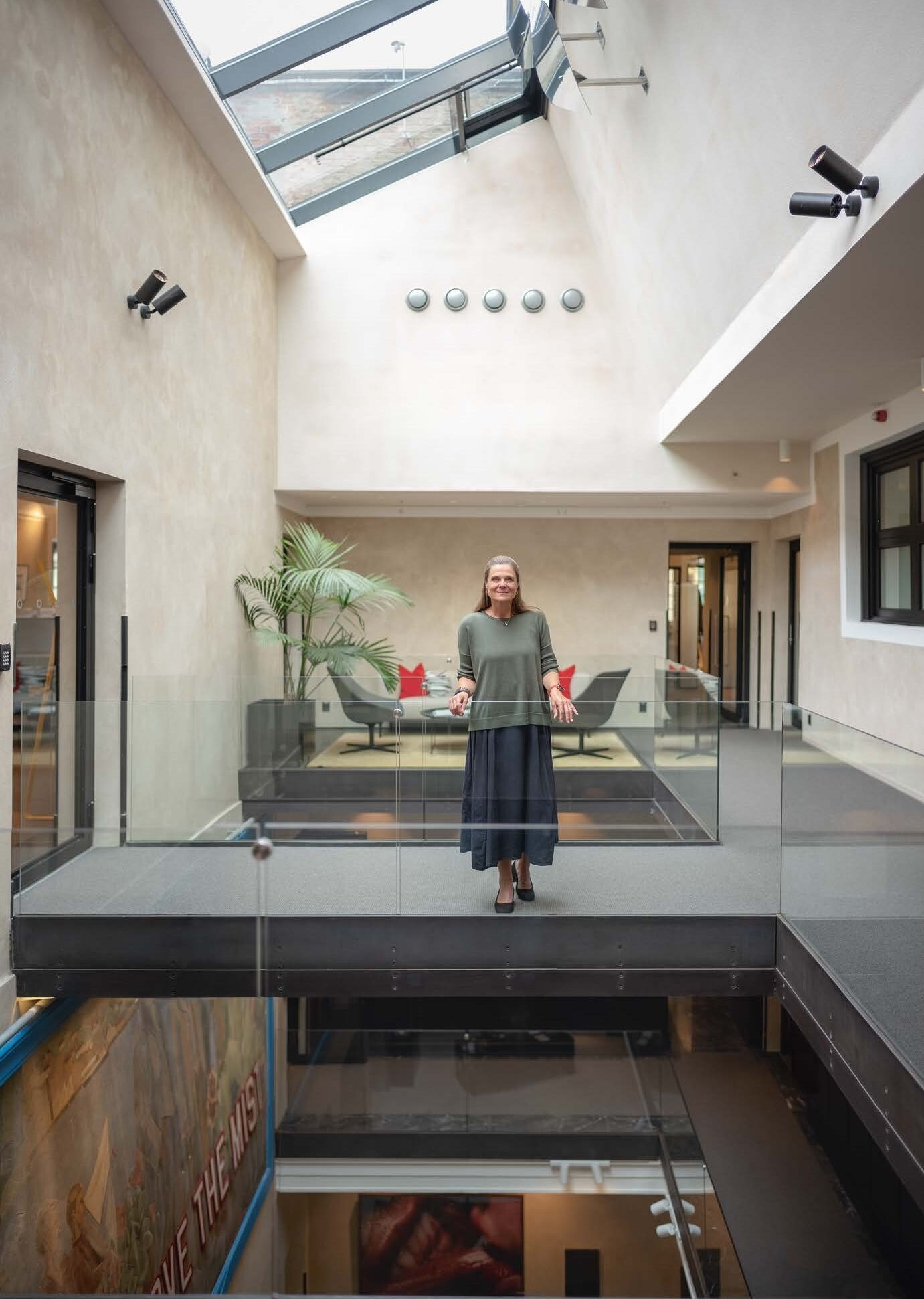
The beautiful brick building located at the beginning of Bygdøy Allé is the headquarters of Aars, the Møller family’s business. This building is where most of the Møller Collection is normally housed, and it is also the workplace of Nina Sørlie, the collection’s curator.
A couple of days after the opening of the exhibition “Eksponert” at the Henie Onstad Art Center on Høvikodden, we’ve arranged a meeting with Nina Sørlie. We’re a little early and run into her as she’s in the process of carrying framed photographs into the building from a van.
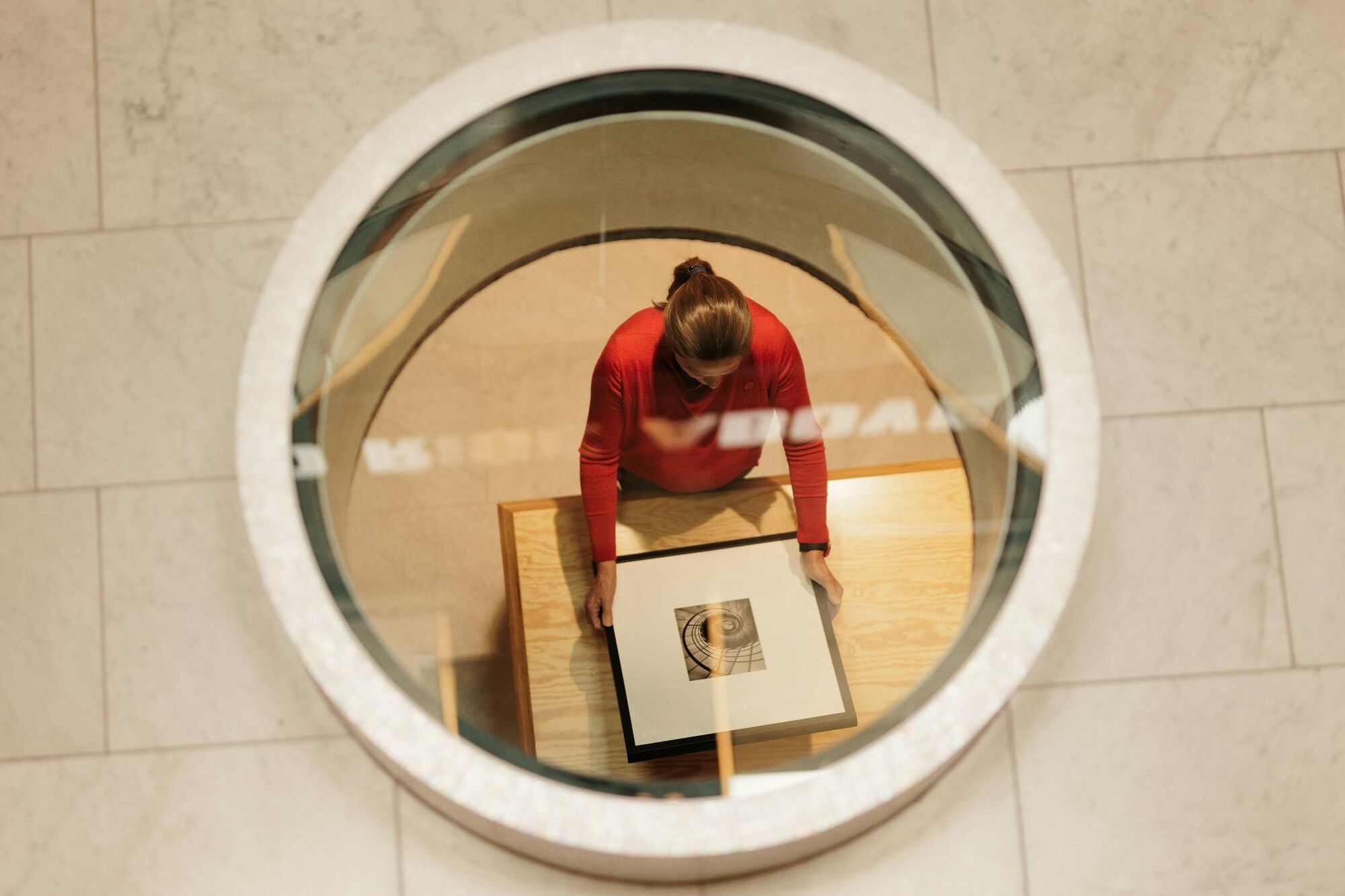
“These are photos that have come back from Henie Onstad—photos that weren’t included in the exhibition. There have been a few rounds of photos going back and forth during the planning of the exhibition over the past year,” she explains.
Through mid-December, the public can enjoy viewing photographs from the Møller Collection at the Henie Onstad Art Center. “Eksponert” is curated by Henie Onstad’s photography curator Susanne Østby Sæther and features 270 works from the collection. Sørlie, with her in-depth knowledge of the entire collection, has worked closely on the organization of the exhibition, as well as on the accompanying book “Eksponert,” published by Press.
Throughout her long career in the art world, Nina Sørlie has worked for, among others, the National Museum (then the National Gallery), Blomqvist Art Gallery, the Kistefos Museum, Christen Sveaas’s private collection, and Kaare Berntsen. When the latter ceased operations, Sørlie received a call from Harald Møller asking if she would like to serve as curator of the Møller Collection. “It was a fun meeting,” she says, though she pointed out that Harald Møller likely had more knowledge of photography than she did.
But she’s skilled at managing collections and has a keen eye for hanging art. Regardless of Sørlie’s knowledge of photography, he chose to take a chance on her. When she started the position in 2013, it was just one day a week. Now it’s a full-time position, and the collection has grown from 600 to 1,000 photographs.
A Versatile Daily Life
Sørlie holds a master’s degree in art history, and while working on the collection, she also developed an interest in pursuing further education in photography. With knowledge comes interest, and with interest comes passion and commitment. Sørlie finds that photography can be a completely different tool for communication than both painting and sculpture, the mediums she has primarily worked with in the past.
“It’s rare that I’m not stopped when we’re hanging new photos—there’s a low barrier to commenting on a photograph. We like to think of photography as a more democratic medium.”
In terms of expression, photography isn’t that different from other art forms, and when it comes to caring for a collection, it’s certainly comparable. But photography is harder to appraise,” says Sørlie.
All the meeting rooms in the building are dedicated to a photographer. In the room where we’re sitting, one of Per Berntsen’s winter scenes hangs on the wall. On the way to the meeting room, we pass a huge print of Tom Sandberg’s image of a woman lying on a dock with her butt exposed. The photo covers the entire wall
– “This photo used to hang in the reception area, but we decided to move it,” says Sørlie. “Some people are offended by images like this; we have to be mindful of religion, nudity, and the #MeToo movement, for example.”
Sørlie describes her job as varied, which suits her perfectly. She’s the kind of person who likes to get things done and keep track of everything, and she’s not afraid to roll up her sleeves either. In other words, no run-of-the-mill existence.
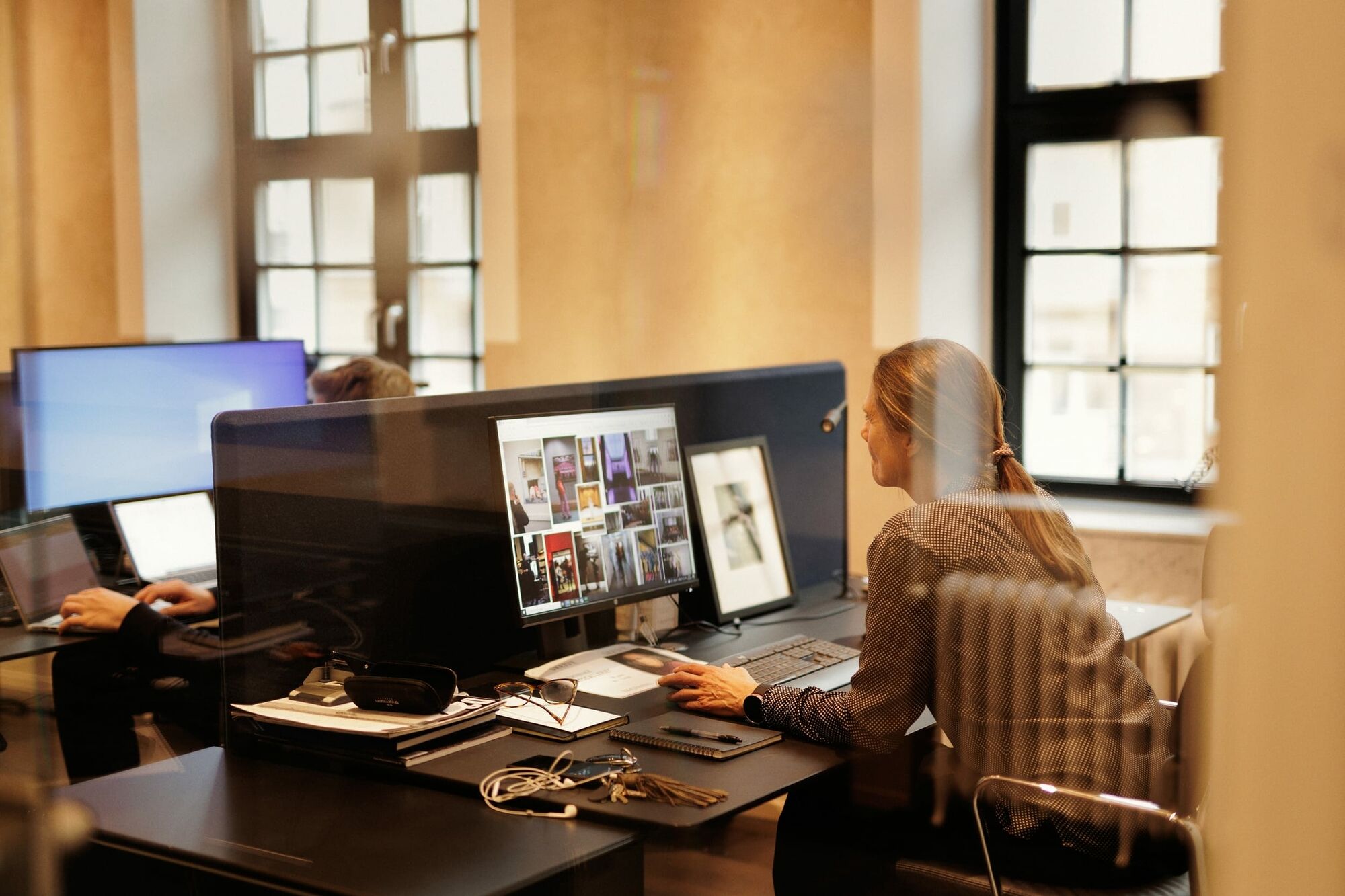
– All the images in the collection are registered in a database that’s constantly updated. I know exactly where every image is at all times. It’s also part of my job to keep track of what’s happening at galleries and auctions with an eye toward acquisitions.
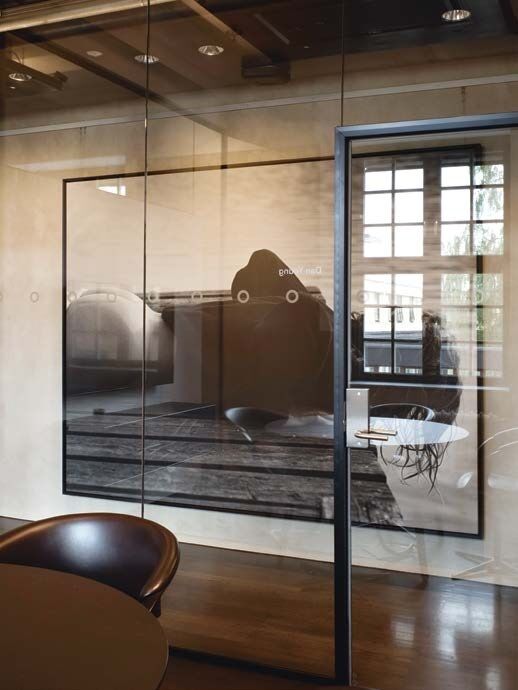
Sørlie's surroundings are filled with photographic art, as seen here in a photograph by Tom Sandberg. Photo: Bjørn Wad.
One of the things I enjoy most is creating satellite exhibitions—smaller exhibitions displayed throughout Møller Eiendom’s premises, both in the spaces they rent out and in the company’s own office spaces. What goes where is entirely up to me. I handle all the logistics, arrange for transportation, and hang the pictures myself whenever physically possible. Both at the co-working space Mesh—which recently moved into Møller Eiendom’s premises at Youngstorget—and at Laboratoriet on Harbitz Torg, the walls are filled with images from the collection. “We’re using the collection more and more actively, and we want everyone to feel a sense of ownership over it,” Sørlie explains enthusiastically.
At Laboratoriet on Harbitz, the series “End Game” by Mikkel McAlinden—which is now on display at Henie Onstad—was previously exhibited. The staff were sad that the photos would be gone until Christmas. We picked up the photos just before the opening at Henie Onstad, and a few days later we had hung Hilde Honerud’s photos from the “GYM” series. Honerud’s photos fit right in—they have a story to tell. The most satisfying part is cracking the code with the rooms—not necessarily to make them look pretty, but to spark a dialogue.
The Møller Collection doesn’t have a specific focus; the photographs are acquired from the heart, con amore, but throughout there is a dialogue with the past, with the classical, without it being a “must.” Over the past year, a small group has been formed consisting of members of the Møller family and key figures from Møller Eiendom and Møller Mobility who, together with Sørlie, meet once a month to discuss new acquisitions. The group works well, says Sørlie, and he emphasizes the importance of its diverse age composition.
Oslo’s First Photography Festival
When Møller Eiendom purchased the old library at Hammersborg in Oslo in the fall of 2020, the plan was for it to house photography in some form. Eventually, the photos from the collection will be displayed there, and the hope is that photography-related activities will take place there, ideally involving multiple participants. It’s a large building with many rooms, and at the moment there is considerable uncertainty regarding what the City of Oslo will allow them to do with the building.
Sørlie explains that to mark the fact that the building will eventually be used for photography in some form, a photography festival—Oslo Negativ—will be held for three weeks in early October. All galleries in Oslo that represent photographers were asked if they would like to participate. At the time of writing, there will be 19 galleries, as well as NTB and the Oslo School of Photographic Art. The festival will be the first of its kind in Oslo and will feature two major exhibitions as its main attractions: Edward Burtynsky and Nick Brandt. Nick Brandt will present a brand-new series that will be launched at Oslo Negativ, among other venues.
“Burtynsky is a personal favorite, and this was a golden opportunity to introduce him to Norway,” says Sørlie. The festival will be a fun-filled event, buzzing with activity, and one the whole family will want to attend. Among other things, we’ll set up a darkroom where visitors can try their hand at developing photos, and we’ll create a Hall of Fame with paparazzi-style flashes. There will be plenty of opportunities for the audience to participate in activities. In the library’s main hall, we’re planning a program that includes artist talks and lectures, and we have our own small movie theater to screen videos and films. The audience will also get to see rooms that no one has seen before—the building is full of surprises.
The project and communications agency The Oslo Way, led by Lars Tefre Baade, is organizing the event itself and handling all the practical details. So, all that’s left to do is look forward to the first three weeks of October.